Heads up: I may earn from links in this post. It never changes the verdict.
Is Pickup Music worth it? After spending 100+ hours using the platform, completing the Late Beginner Pathway, moving into Intermediate, and receiving personalized feedback from their coaches, here’s what I actually think.
I’ve always been a pretty inconsistent guitar player. I’d learn something, play for a while, get frustrated, and eventually stop practicing.
The biggest problem was that I never really knew what I should be working on. I could learn songs, but I wasn’t getting much better at actually playing guitar.
That’s where Pickup Music came in.
I signed up expecting another online guitar lesson site. Instead, I found myself actually sticking with it. I spent the next six months working through the lessons, practicing regularly, and slowly getting better.
Here’s what I thought after putting more than 100 hours into it. Here’s what I thought…
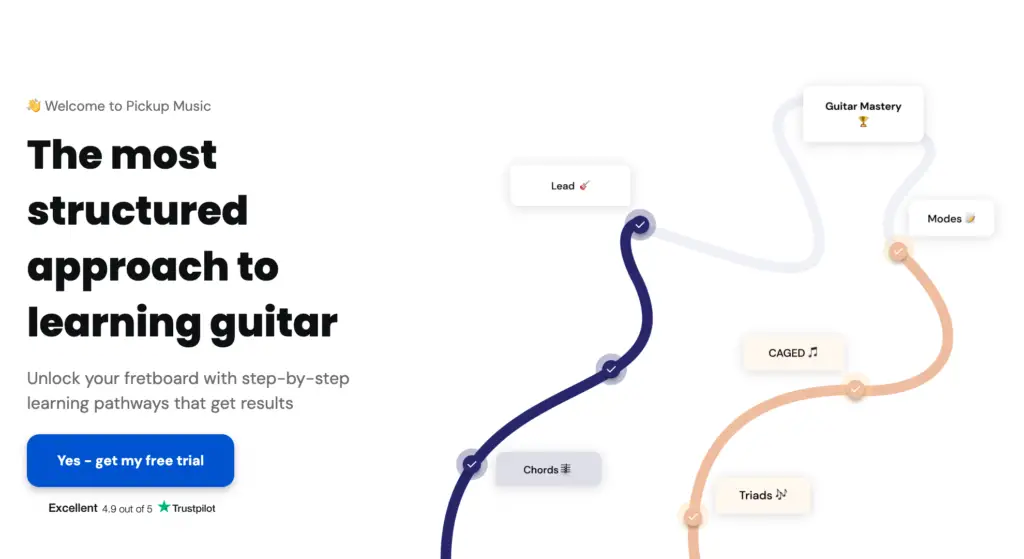
This isn’t your average YouTube tutorial or “quick hack.” It’s a full-on roadmap.
After spending over 100 hours with Pickup Music, I’ve made breakthroughs I thought would take years. And today, I’m going to break down exactly what this platform offers:
- Lessons so well-produced you actually want to keep practicing.
- A variety of courses that grow with you, no matter where you’re starting.
- A community of players and events that keep you motivated (and accountable).
- And a structure designed to eliminate guesswork—so you can finally move forward.
If you’re tired of feeling stuck and ready to make real progress, let’s dive in.
Updated for 2026 — see what’s changed.
Pickup Music Review: My Quick Verdict
Is Pickup Music worth it?
After six months of using it, I found Pickup Music particularly useful because it solved the biggest problem I had as a self-taught guitarist:
I never really knew what I should practice next.
Instead of jumping between random YouTube lessons, I had a structured path to follow. I could work through lessons, apply what I learned to actual music, record myself playing performance pieces, and receive feedback on what I was doing wrong.
What I liked most
- Structured learning Pathways
- A clear progression from one skill to the next
- Performance pieces that force you to actually use what you learned
- Personalized video feedback from coaches
- High-quality video lessons
- Backing tracks and interactive tabs
- A large library of additional lessons and live sessions
- A focus on becoming a better musician, not just learning guitar tricks
What I didn’t like as much
- There is a lot of material, which can feel overwhelming at first
- The structured approach won’t appeal to everyone
- You still have to put in the practice—no online course can do that part for you
- If you already know exactly what you want to learn, a more targeted approach may make more sense
Current Pickup Music pricing
At the time of this update, Pickup Music’s website lists:
- Monthly: $29.99/month
- Annual: $179.99/year
- Free trial: 14 days
- Money-back guarantee: 60 days for qualifying first-time customers who subscribe through the website
My Guitar Struggle
Like a lot of kids, I started playing guitar in middle school, hoping to become a rock star.
Fast forward 15 years, and life got busy.
Although I could play some riffs, I lacked a structured approach and struggled to keep rhythm with backing tracks.
My playing felt stagnant, and the joy of making music had faded.
Eventually, I put the guitar down…
and slowly forgot about it.
Pickup Music changed that. Those six months were my longest stretch of consistent practice in 15 years.
I’m going to tell you how I did it.
My 6 months with Pickup Music
I want to give you a deep dive into my journey so far with Pickup Music so you can see how it’s structured and decide whether it fits your learning style and level.
When you first sign up, you get a 14-day free trial.
I wanted to make the most of it.
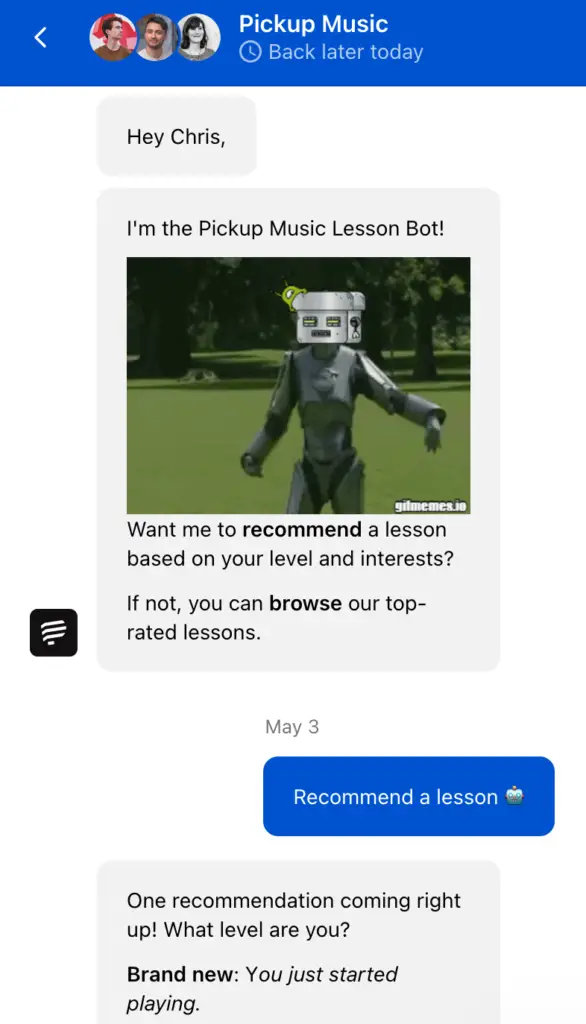
It was pretty easy to decide on a course, or “Pathway”, because they have some onboarding questions and a chat system where you can ask for advice if you’re unsure where to start.
I started with Late Beginner because after 15 years of unguided noodling, I’d forgotten a few things, to say the least.
Late Beginner
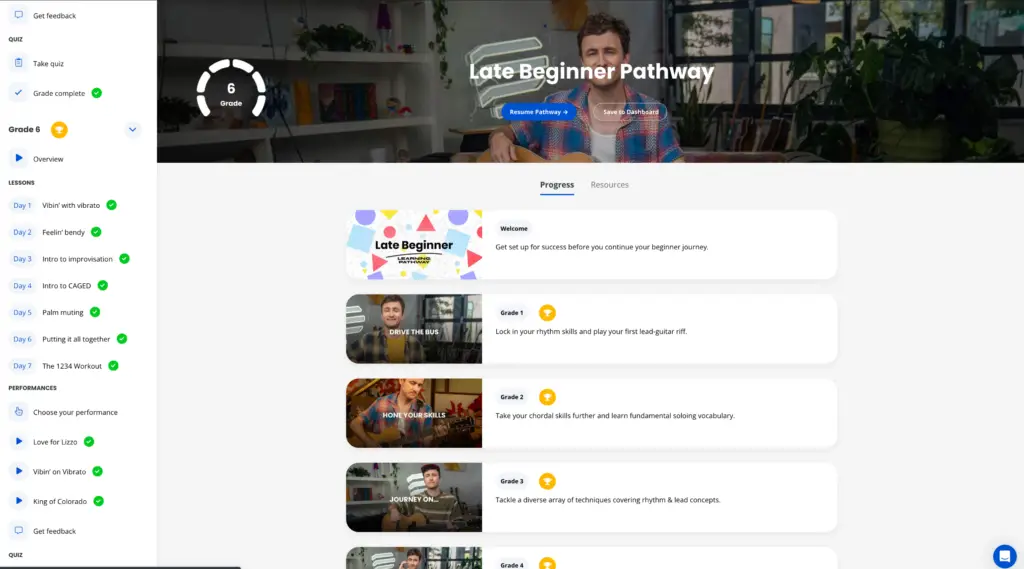
Here’s a quick outline of how a Pathway works.
Pickup Music uses a structured learning system called “Pathways.” Each Pathway is like a roadmap, consisting of 6 Grades with 7 lessons per Grade.
The lessons are well-organized and focus on applying what you learn.
A key feature of the Pathway is the use of original songs as performance pieces. Students record themselves playing these pieces and submit them for personalized feedback from experienced coaches.
The “Drive the Bus” lesson, for example, drills different rhythmic divisions over a popular chord progression.
Each lesson ends with a Jam, where you play what you learned without tabs. It’s a huge help for internalizing the material.
You can check out the full curriculum at their website with full details
Fast forward 7 days…
I’d refreshed my memory, picked up some new chords, and it was time for my first performance piece.
Unfortunately, I don’t have the recording…
But I have the feedback.
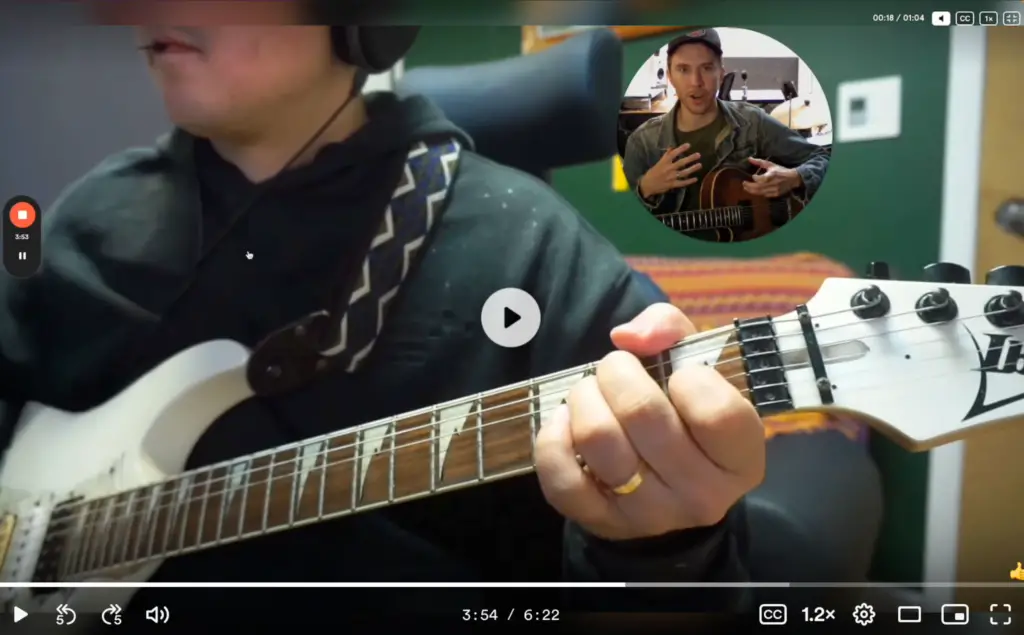
One of the highlights of Pickup Music is the personalized feedback system.
This is Ben.
He has provided in-depth feedback on 4 of my performance pieces so far. It truly feels like he’s on this journey with me – referencing past feedback and tailoring his comments to my specific areas of improvement.
Moving through the Late Beginner Pathway here are some of the topics covered
- Essential Techniques: Bar chords, 7th chord shapes, power chords
- Playing Styles: Intro to fingerstyle, blues rhythm & lead techniques
- Music Theory: Major Scale, Major Pentatonic, I vi IV progression (and likely more!)
…just to name a few
Thanks to Ben’s feedback, I’ve seen significant improvement in areas like keeping time with the music and mastering palm-muted arpeggios (which we’ll see in the next section).
Grade 3 – Blues Lick
Since I didn’t have much experience playing long pieces, I struggled to keep my place in the music.
“Do I need to repeat this line 1 more time?”
“Do I need to wait 1 measure before coming in?”
“Oh, I came in too early…”
The personalized feedback from Pickup Music was invaluable here. After submitting my performance, they provided specific tips on how to internalize rhythm, which significantly improved my timing.
Grade 5 – Quick Switchin’
The challenge I faced with this track was the intro and keeping steady 8th notes when the drums only hit on 2 and 4
Grade 6 – Love for Lizzo
Grade 6 introduced palm-muted arpeggios. While I nailed the chords, the arpeggios needed work.
Here again, the feedback was spot-on, providing guidance that helped me improve this technique.
We’ll see how I put these palm-muting skills to use in the Intermediate level.
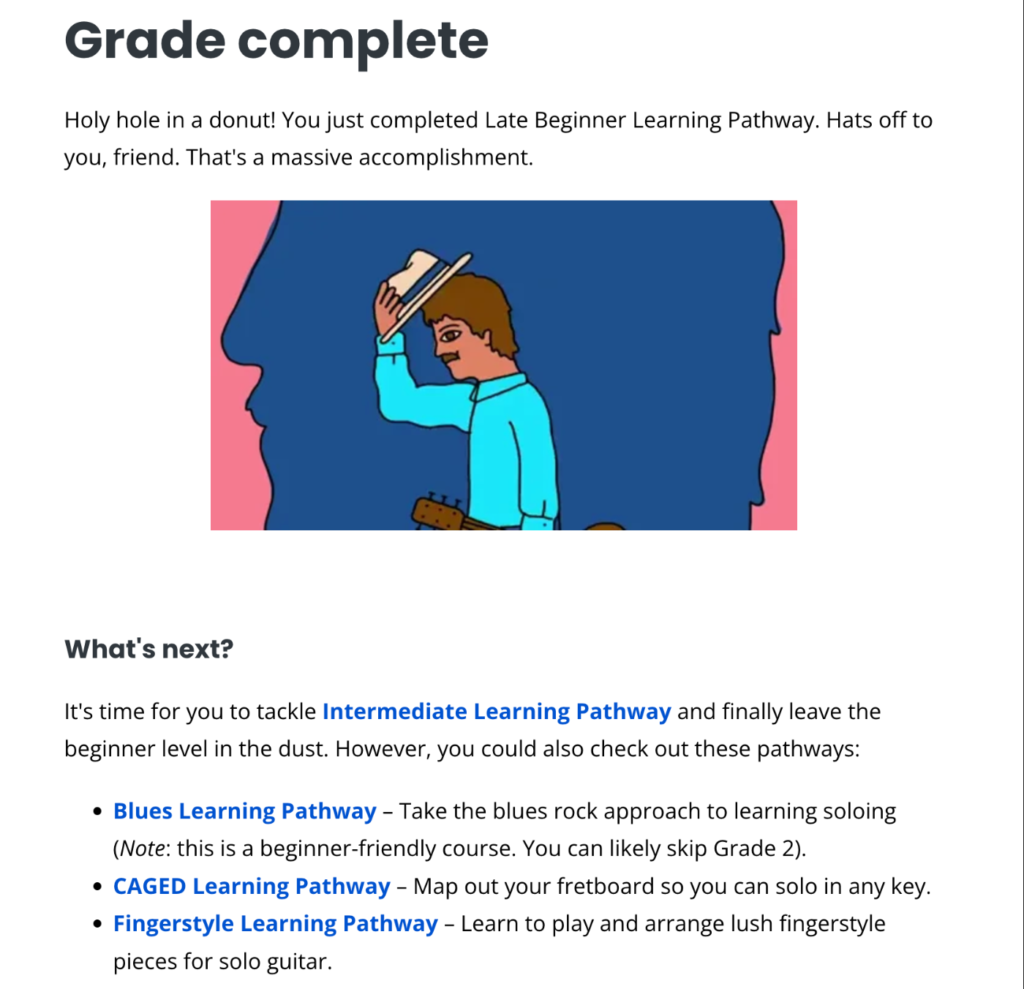
After finishing the Pathway, I got this nice little certificate.

Moving on to Intermediate…
Intermediate Grade and CAGED
A key focus at this level is adding feeling to your playing. Lessons explored techniques like phrasing and dynamics to add expression.
For my performance piece, I chose “Ouchie,” a track that (perhaps fueled by a touch of ego!) turned out to be the most demanding yet.
Intermediate Grade 1 – “Ouchie”
This was the one I had the most fun with and practiced the most.
The hardest part was keeping time on the single-string line, since some notes are syncopated.
This experience highlighted a recurring theme in Pickup Music’s approach: even seemingly simple melodies can pose nuanced rhythmic challenges that ultimately help you grow as a musician.
Grade 2
Grade 2 focuses on lead playing, so it goes deeper into scales.
The performance piece here is a Khruangbin-inspired tune with an emphasis on lead playing.
As you can hear, my palm-muted arpeggios have come a long way thanks to the feedback and practice from the Late Beginner Pathway!
From there, I moved into Grade 3 and started adding lessons from the CAGED Pathway.
I didn’t stick only to the Pathways, either…
There are weekly live Zoom lessons, and you can watch the replays on demand. These lessons cover a wide range of topics, from jamming techniques to production essentials.
I found the “Production Week” lessons particularly useful. Learning about drum programming and songwriting from a producer’s perspective was super helpful.
Afterward, I put it to use by programming the drums from one of the performance pieces in MIDI, by ear.
Between this and the structured lessons, I finally had the confidence to start working on my own music.
I see Pickup Music as a way to become a better MUSICIAN through guitar.
My Core Takeaways
Pickup Music helped with every problem I’d been stuck on.
I couldn’t find a good practice routine…SOLVED.
I couldn’t get feedback on my playing…SOLVED.
I couldn’t learn songs in a musical way…SOLVED.
I got past the difficulty of trying to be a self-taught guitarist who didn’t have a lot of time. I didn’t want to spend half my practice time planning instead of actually learning.
Does that sound familiar to you?
I don’t have to worry about that now, or at least, worry about it a lot less.
Also, I feel that it has a more musicianship-oriented approach that has made me a better musician not just a better guitarist.
Okay so enough about me and my journey…
How can Pickup Music help YOU?
Whether you’re a complete beginner or an advanced player, there’s something here for you, but the platform is really built for beginner and intermediate players.
But it is focused on the beginner and intermediate players.
The advanced players may benefit from exploring some of the genre Pathways outside their comfort zone
I would consider myself a lower-intermediate player, and I would have to say there are YEARS worth of lessons on the platform that are laid out in a clear, linear path toward mastery, not only of guitar but of musicianship as a whole”
Pickup Music a Deeper Dive (Review Details)
Lesson Quality – Videos
Pickup Music’s video lessons stand out with multiple angles, downloadable backing tracks, and interactive tabs that let you slow down the teacher.
Each lesson is split into several videos:
- Overview video
- Individual exercise videos
- Jam Video
You get multiple angles so you can get a clear visual of what’s being played on the guitar.
At the end, you get a backing track tailored to the exercises from the lesson, and you’re free to get creative when jamming over it.
The interactive tabs allow you to loop over sections of the video and change the playback speed.
I know I had to do that a few times with some of the more difficult exercises.
Teachers
As highlighted earlier, while the video production level is impressive, it’s the teachers who truly add value to the learning experience. Their expertise and guidance are invaluable, making the course an excellent investment for anyone seeking to improve their skills.
The teachers I have watched and received feedback from have all been top-notch and entertaining to learn from. Karl brings a lot of character and charm to his lessons in the Late Beginner and Intermediate pathway.
Course Types
Pathway courses are not the only lesson types they offer. Let me explain briefly.
- Masterclass – shorter groups of lessons that focus in-depth on a particular playing style or genre (usually about 10 lessons)
- Songsquad – where Pickup Music instructors perform their own songs and take you through them step by step
- Essential Licks – short video lessons that cover all the elements of a specific lick
- Artist Toolkit – longer form lessons and interviews that give insight into the life of a professional guitar player
- 5 Minute Lessons – quick lessons that cover a specific aspect of the instrument in 5 minutes
- Live Lessons & Replays
Something that should be mentioned is that everything here is all original music from the Pickup music team or the instructor’s own songs as in the Song squad lessons
Each lesson is short enough to tackle in just 10-20 minutes. So, even if you’ve got a hectic schedule, you can still get your guitar fix and improve your skills.
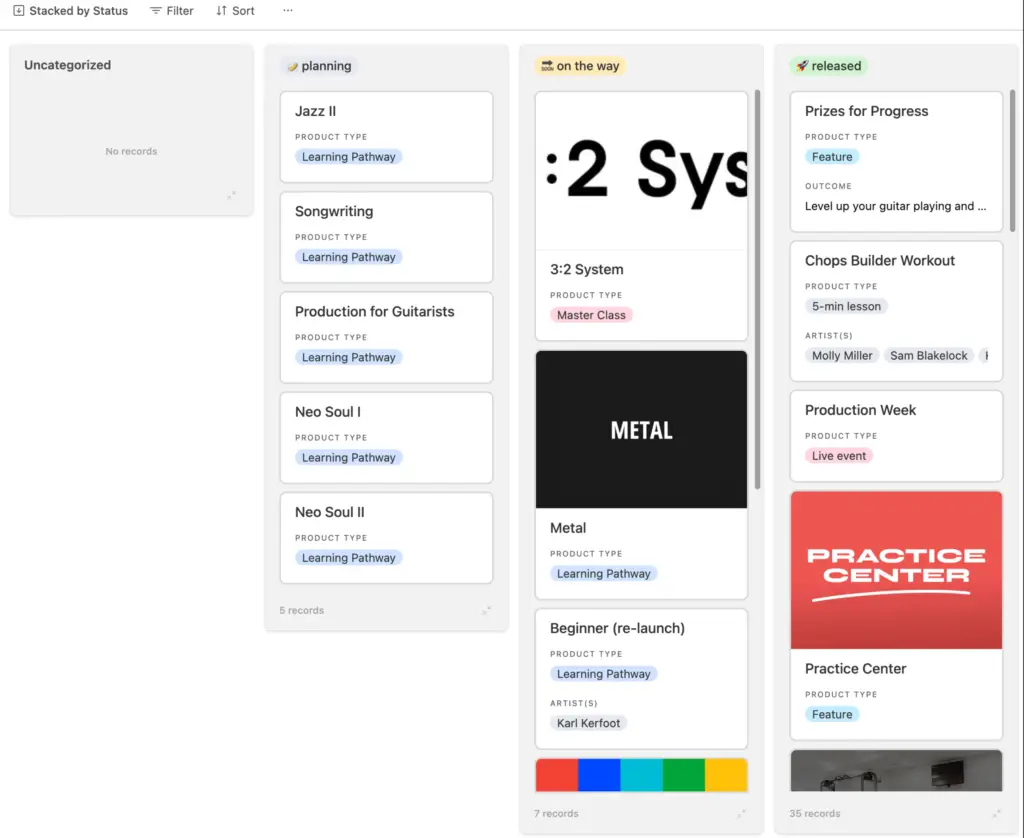
They are constantly adding new courses and lesson material. You can check out what they have in the works in their public roadmap.
Personally, I am excited about the Metal and Songwriting Pathway!
Feedback

The 1-on-1 feedback system is something I have found unique to Pickup Music. I haven’t heard of a platform giving this kind of feedback and would usually only expect it if I were taking private lessons.
They have a range of trusted coaches who are active in the Pickup Music Community and record video feedback on the performances you submit.
I have had feedback range from 4 to 7 minutes long, but the length doesn’t matter – it’s the value you get out of it, right?
Well, I have found them very valuable, and I am super excited when I get an email saying that the feedback has arrived.
Here is a link to one of my feedback videos
Community and Events
Pickup Music also has a community corner. They have a very supportive community of other guitarists who post videos of their progress and share information.
Pickup Music hosts live chat sessions or Q&A events with instructors. This can be a great way to connect with other students and get answers to your guitar-related questions.
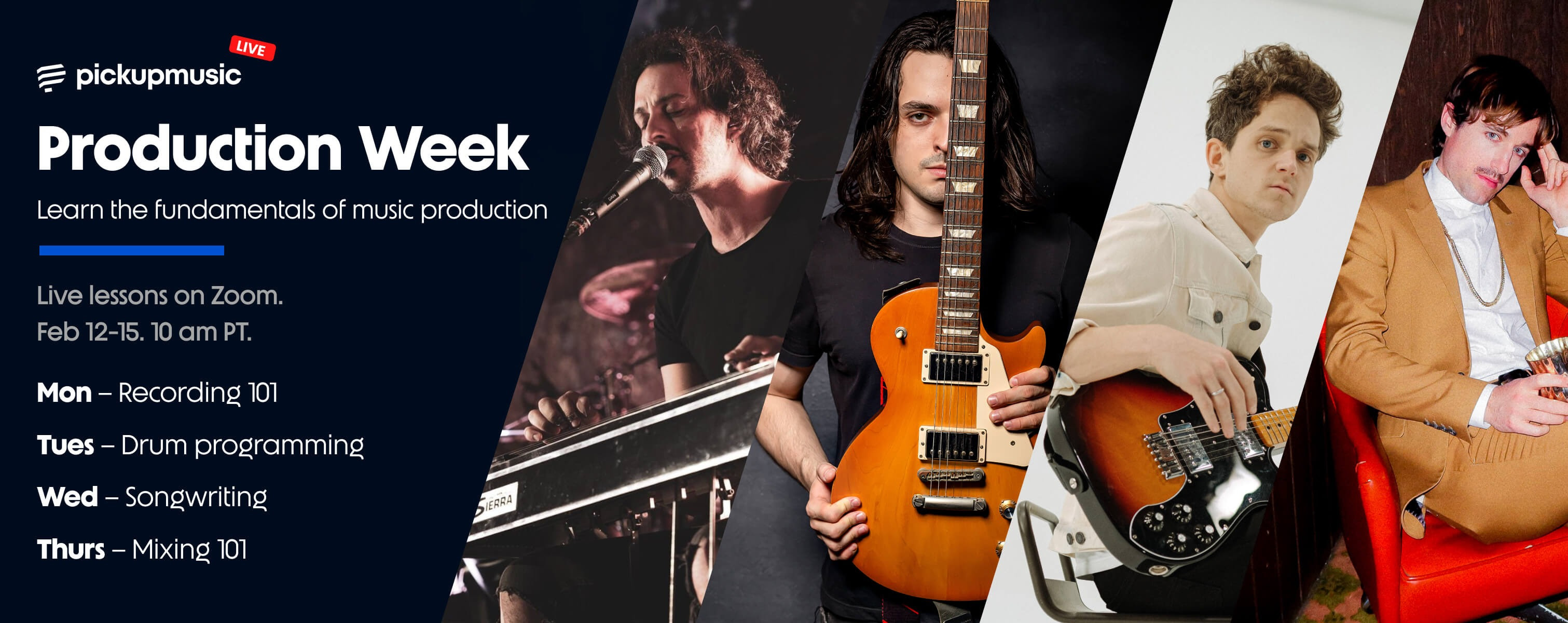
They also have week-long live lesson events which focus on different aspects of music and production. Here are some that I have seen during my time at Pickup Music:
- Production Week
- Jamming Week
- Ear Training Week
Don’t worry if you can’t make it live!
They post replays of all the live lessons in the community section.
Pricing and Value
You might be wondering, “Is Pickup Music worth the investment?”
Let’s talk about the cost.
Traditional guitar lessons typically range from $30 to $60 per hour, depending on your location and the teacher’s experience. That adds up quickly, especially if you’re aiming for consistent progress.
At $40 per hour for two lessons a week, you’d spend over $4,000 a year. With Pickup Music, you get unlimited access for less than $200.
Pickup Music offers a much more affordable alternative without sacrificing quality. With an annual plan at just $179.99 (that’s less than $15 a month), you gain access to hundreds of hours of expertly crafted lessons, personalized feedback from experienced coaches, and a supportive community. It’s like having a personal guitar tutor available 24/7, at a fraction of the cost.
And if you’re unsure about committing to a full year, the monthly plan for $29.99 is a great option to test the waters. Plus, you can start your journey completely risk-free with the 14-day free trial.
Pickup Music’s free trial gives you the chance to experience their in-depth feedback and practical learning style.
When I went through the trial, I was able to complete a grade record a performance piece within those 14 days and get some awesome feedback.

2026 Update: What Has Changed With Pickup Music?
Pickup Music has changed a lot since my six months with it. Everything above is from the version I used. This section covers what’s different if you’re signing up now.
The New Platform
The biggest change is the lesson player. The video and TAB are properly synced now, and the interactive TAB follows along with the lesson instead of drifting.
You can slow a section down, loop it, and switch between TAB and standard notation without stopping and restarting the video. The old player was a little clunky at times, so this fixes one of my few real complaints.
The Pickup Music Piano Learning Pathway
Pickup Music now has a full piano curriculum, built the same way as the guitar side. The Learning Pathways, taught by Dion Todman, run from Beginner to Late Beginner to Intermediate, and there’s a new Jazz Learning Pathway with Rob Araujo.
I started with the Beginner Learning Pathway, the easiest one, because I wanted to see how it’s built from the ground up.
It moves faster than I expected. Within the first few days you’re already working on chords, inversions and arpeggios. They aren’t just explained to you; you’re actually getting them into your fingers.
That’s the same thing that kept me going on guitar: you always know what to practice next, and you’re playing real music early instead of drilling theory in isolation.
More Than Just the Learning Pathways
The Learning Pathways are still the core, but there’s more around them now: short lessons, challenges, songs, artist series, workouts and jam tracks for when you don’t want to follow a structured course.
There are also weekly live lessons, and 1-on-1 video feedback from coaches is still part of the membership. The feedback was one of the most useful parts of my original six months, so it’s good to see it’s still there.
Final Thoughts
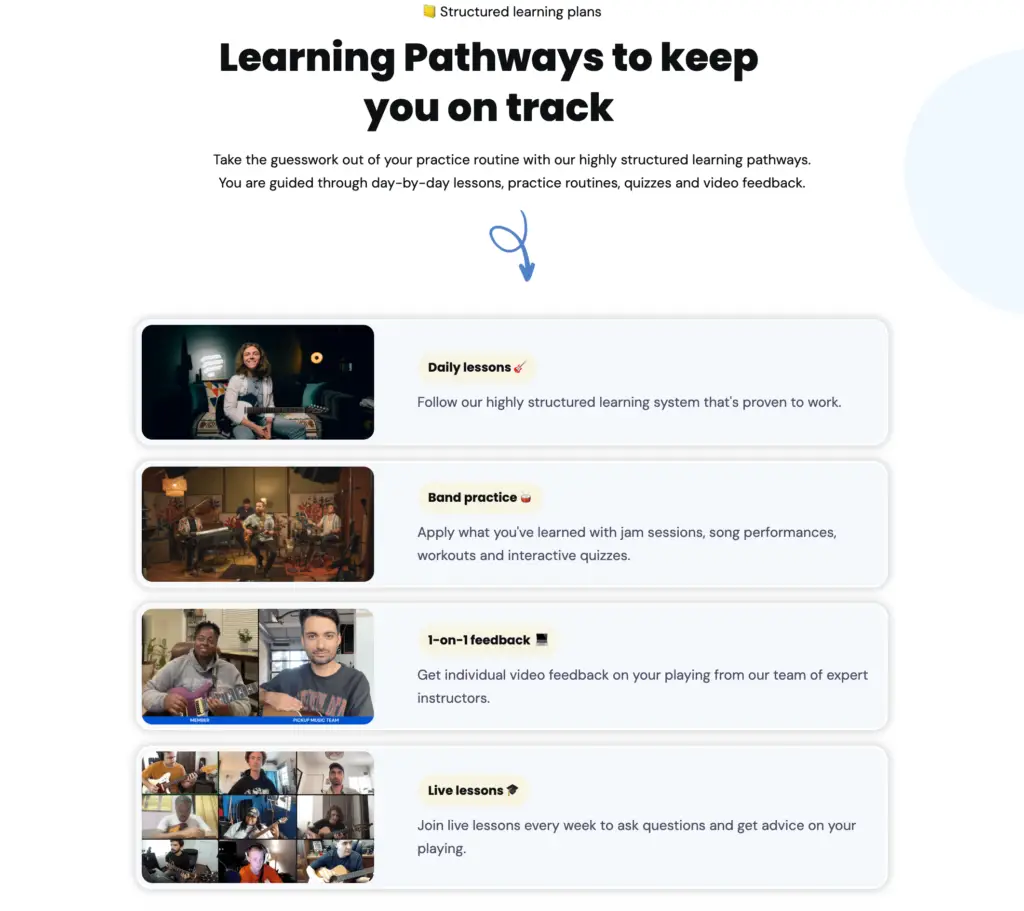
So, is Pickup Music the right platform for you? Here’s the bottom line:
- Structured Learning: If you thrive with a clear roadmap and focused lessons, Pickup Music’s Pathway system is fantastic.
- Personalized Feedback: The in-depth, personalized feedback from experienced coaches makes a real difference in identifying your weaknesses and guiding your improvement.
- Practical Application: Pickup Music goes beyond theory, emphasizing practical skills through exercises, jamming, and performance pieces.
- Beginner to Advanced: While I focused on the Late Beginner Pathway, Pickup Music caters to learners from beginner to advanced levels.
I used to think guitar was for other people.
Six months of Pickup Music changed that. I’ll send you what’s actually working in my practice, what isn’t, and the lessons, gear and apps worth your time.
No sponsored picks. Unsubscribe in one click.
Get the good stuff, skip the hype.
One email a month: what's actually worth your money and what isn't. No sponsored picks, no filler.
Unsubscribe in one click.